All Categories
Featured
Choosing the Best Legal Debt Strategy
Table of Contents
Bankruptcy lawfully enables individuals or companies who are not able to repay their financial obligations to seek relief through court-supervised reorganization or liquidation (sales) of assets. It supplies a fresh monetary start for debtors while guaranteeing fair treatment of lenders, but specialists say it needs to be a last hope to settle your monetary issues.
While bankruptcy frequently brings a stigma, it's important to reserve those concerns and focus on discovering a service that can provide relief. Everybody's monetary journey is various, and your individual limits for tension and challenge ought to assist your decision. "The most significant mistaken belief, by far, is that insolvency is a BAD thing," said Adrienne Hines, author of "Bankruptcy Magic: The Life-Changing Power of Debt Relief with Self-respect" and an insolvency and employees settlement attorney with Wisehart & Wright, Co., LLC, in Sandusky, Ohio.
Evaluating Debt Liquidation under 2026 LawsBeing smart about your alternatives and exploring your options are more crucial than being embarrassed or embarrassed.": An individual or company that owes money, items, or services to another party. A bank, individual, business or other organization that provides cash, extends credit, or offers services with the expectation of being repaid, generally with interest.
: A court order that releases a debtor in personal bankruptcy from liability for specific financial obligations and forbids creditors from continuing to try to gather them. The procedure in which some of a debtor's assets are sold to pay off creditors. Financial obligation that is backed with security such as a home or automobile, which a financial institution can take if you default on a loan.
Personal bankruptcy offers lenders an opportunity to be at least partly repaid when possessions belonging to a private or business are liquidated, suggesting the properties are converted into money which is then committed the debtholders. All bankruptcy cases are filed in federal court. Judges examine the bankruptcy filing to identify a debtor's eligibility and after that choose whether to release that financial obligation.
Legal Support for 2026 Chapter 13 FilersStrategies for Reducing Lawyer Costs in 2026
A lot of cases are managed between the judge and trustee and do not need the debtor to appear in the court proceedings. A decision can be made to discharge, indicating the debtor is no longer lawfully responsible for paying those debts. Or the judge might dismiss the filing if he or she thinks the individual or organization has the means to pay their debts.
Declare bankruptcy can be a saving grace for people drowning in debt. The numbers support that contention. The American Bankruptcy Institute states that 95.3% of individuals in Chapter 7 personal bankruptcy are successful when they are represented by an attorney, and United States. Bankruptcy Court stats show an even higher percentage in Chapter 7 cases that aren't dismissed or transformed into another type of bankruptcy As you'll see below, you may have to certify for Chapter 7 bankruptcy based upon your earnings.
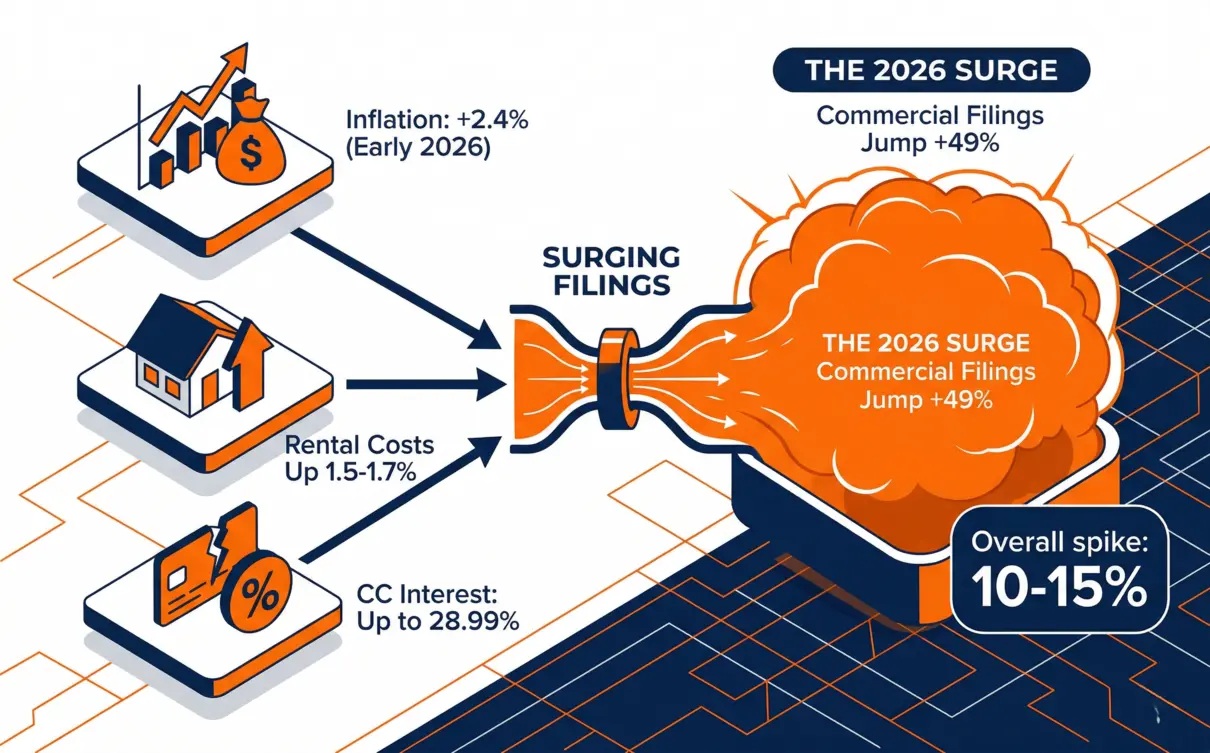
Comprehending these options can help individuals and companies choose the finest path to solve their debts and gain back financial stability. Chapter 7 and Chapter 13 are by far the most common types of bankruptcy, accounting for over 98% of bankruptcy filings based on early 2026 data.
Historically, it's been the most extensively utilized kind of bankruptcy because it's relatively economical and offers the quickest financial obligation relief. That trend is continuing, as Chapter 7 filings increased by 17% in the very first quarter of 2026 over the very first quarter of 2025, according to information from Epiq AACER released by the American Insolvency Institute.
How to File for Bankruptcy Legally in 2026
You also might be permitted to keep key assets thought about "exempt" residential or commercial property, though non-exempt property will be offered to pay back part of your debt. Simply know that property exemptions vary state-to-state. By the end of an effective Chapter 7 filing, the majority (or all) of your debts will be discharged, suggesting you won't have to repay them.
Chapter 7 insolvency stays on your credit report for ten years and substantially minimizes your credit score, however your score could enhance in time as you restore your finances. While some people may not qualify due to high earnings, others just can't pay for Chapter 7 insolvency due to the charges and costs.
A Chapter 13 personal bankruptcy involves reorganizing your finances so you can pay back some debts in order to have actually the rest forgiven. This is a choice for people who do not want to give up their home or do not certify for Chapter 7 because their earnings is too high. People can just declare insolvency under Chapter 13 if they have less than $526,700 in unsecured debt in cases filed in between April 1, 2025, and March 31, 2028.

Latest Posts

How to Initiate for Bankruptcy Efficiently in 2026
Key Updates in the Federal Bankruptcy Landscape
Long-Term Consequences of Filing